


HRCI & SHRM Approved Webinar | CEUs = 1.5 Credit Hours
Overview:
In payroll, we calculate the gross wages of an employee by meticulously following strict regulations on what must be or must not be counted as hours worked and taxable income. We pay net paycheck only by the payment method that is permitted. But what about in between? When it comes to deducting from the employee’s gross wages to achieve the net income are you also adhering strictly to the rules?
After calculating an employee's gross wages, the real compliance challenge begins. What must an employer deduct? What may be deducted legally? What can never be deducted? These questions must be answered correctly before every paycheck is processed—and the rules may change for a final paycheck. Payroll deductions must be handled accurately every time. Failing to withhold required taxes can result in IRS penalties, while making unlawful deductions for fringe benefits, overpayments, or other items can trigger federal or state Department of Labor investigations. To make matters more complex, a deduction permitted under federal law may be prohibited under state law.
In this webinar we will discuss what can and what cannot be deducted from an employee’s regular paycheck as well as their final one. Failure to follow the regulations pertaining to employee wage deductions can result in substantial penalties and interest.
What will You Learn:
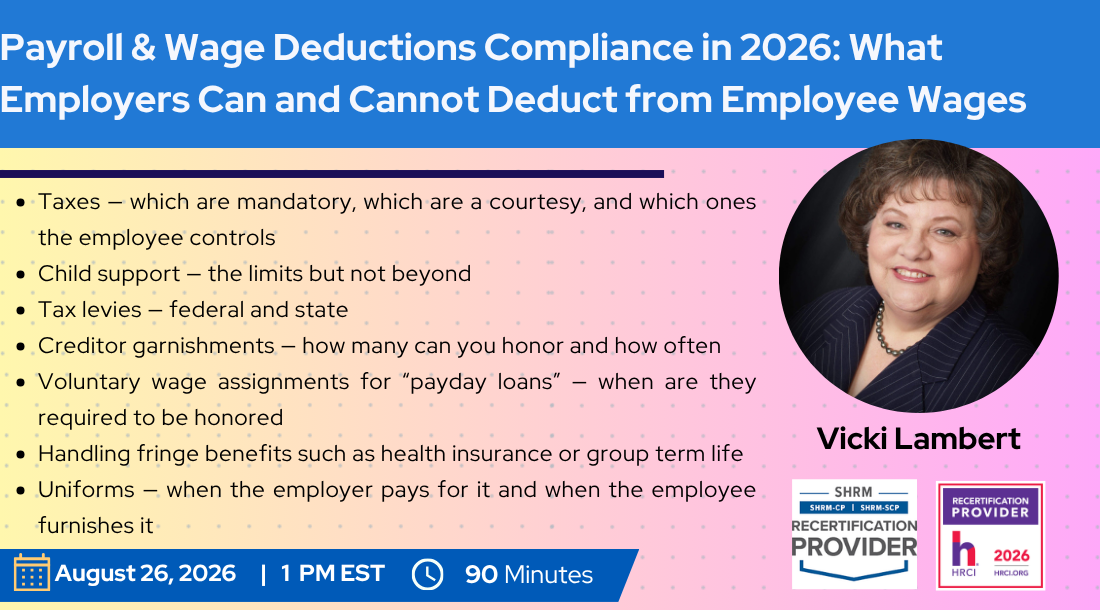
- Taxes - which are mandatory, which are a courtesy, and which ones the employee controls
- Child Support - the limits but not beyond
- Tax Levies - federal and state
- Creditor Garnishments - how many can you honor and how often
- Voluntary Wage Assignments for “payday loans” - when are they required to be honored
- Handling Fringe Benefits such as health insurance or group term life
- Uniforms - when the employer pays for it and when the employee furnishes it
- Meals - when they become part of the employee’s wages
- Lodging - when it is part of the employee’s wages and when is it a perk
- Shortages - the employee came up short, so they must cover that right?
- Breakage - you broke it, so you have to pay for it, legal or not?
- Overpayments - the employee was overpaid so you can just take the money back, or can you?
- Advanced Vacation Pay - the employee knows the vacation hours were advanced so we can take them back when the employee quits can’t we?
- Loans to employees - what terms can be set while the employee is still active and what can be taken when the employee terminates
- Employee Purchases - active employees and terminated employees
- Anti-Wage Theft Laws and the states
Why you should Attend:
Improper payroll deductions are a leading cause of wage-and-hour violations, Department of Labor (DOL) investigations, state labor agency claims, and costly litigation. While employers routinely deduct taxes, benefit premiums, retirement contributions, garnishments, and other authorized amounts, federal and state laws impose strict limits on what may legally be withheld from an employee's wages.
This webinar provides a comprehensive overview of payroll deduction rules under the Fair Labor Standards Act (FLSA), IRS regulations, federal garnishment laws, and state wage deduction requirements in 2026. Participants will learn to distinguish mandatory and voluntary deductions, understand authorization requirements, avoid minimum wage and overtime violations, and develop compliant payroll practices across multiple jurisdictions.
Who should Attend:
- Payroll Executives/Managers/Administrators/Professionals/Practitioners/Entry Level Personnel
- Human Resources Executives/Managers/Administrators
- Accounting Personnel
- Business Owners/Executive Officers/Operations and Departmental Managers
- Lawmakers
- Attorneys/Legal Professionals
- Any individual or entity that must deal with the complexities and requirements of paying employees

Continuing Education Accreditations
SHRM -
CEU Trainers is recognized by SHRM to offer Professional Development Credits (PDCs) for the SHRM-CPSM or SHRM-SCPSM. This program is valid for 1.5 PDCs for the SHRM-CPSM or SHRM-SCPSM. For more information about certification or recertification, please visit - portal.shrm.org.
HRCI -
This webinar has been approved for 1.5 HR (General) re-certification credit hours toward California, GPHR, HRBP, HRMP, PHR, and SPHR recertification through the HR Certification Institute.
The use of this seal is not an endorsement by the HR Certification Institute of the quality of the activity. It means that this activity has met the HR Certification Institute’s criteria to be pre-approved for re-certification credit.